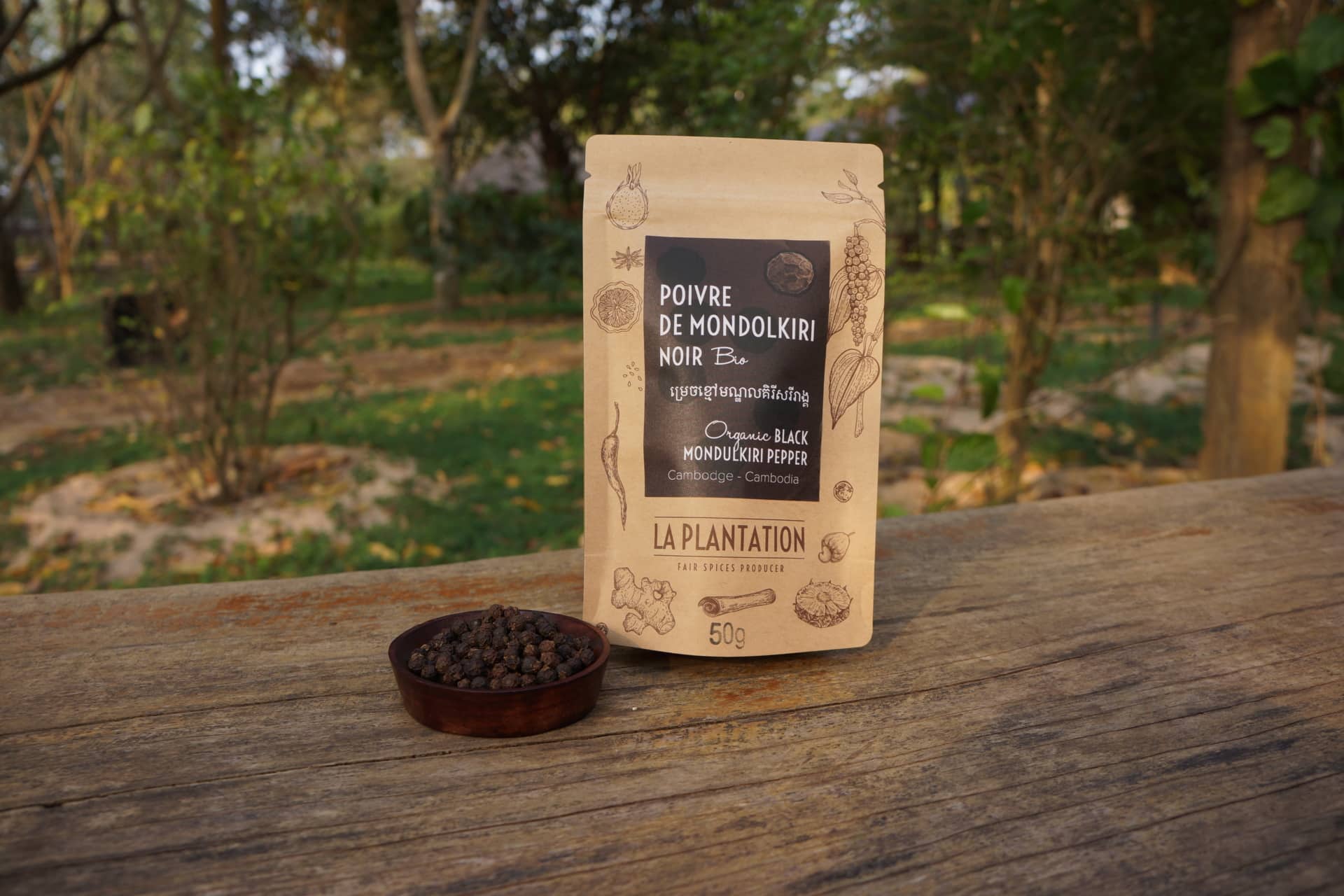
La Plantation’s organic spices are available online in 50g, 500g and 1kg formats, suited to both everyday use and bulk purchasing. This category brings together Kampot, Kampong Thom and Mondolkiri peppers, as well as turmeric, in their certified organic variants.
filter
Organic Spices
Buy Ecocert Certified Organic Spices
La Plantation has been certified organic by Ecocert since 2016. Ecocert is an independent certification body that audits farms and processing facilities for compliance with the European standard EU 2018/848 and the American USDA Organic (NOP) standard. This certification guarantees that the commitments of organic farming — growing methods, permitted inputs, harvest traceability — meet the same requirements as a certification issued in France or anywhere else in the European Union. Organic products destined for the European market also comply with the additional traceability controls that apply to their importation.
Buying a quality organic spice means buying a product whose entire journey — cultivation, harvest, processing — has been verified by an independent external body.
Which Organic Spices Are Available?
La Plantation’s organic range covers three pepper terroirs and one aromatic root, available as powder and as dehydrated petals for infusions. Simply select the organic format from the available options on each product page.
Kampot organic peppers are available in five profiles: black, white, red, dehydrated green and fresh salt-pickled. Grown in Kampot province, they also carry the Protected Geographical Indication specific to this appellation.
Kampong Thom organic peppers cover the same five variants — black, white, red, dehydrated green and salt-pickled — grown in a different Cambodian province with its own distinct aromatic character.
Mondolkiri organic peppers are available in black, white and red, as well as a three-pepper set for discovering all three variants together. Mondolkiri is a mountainous region of Cambodia whose climate and soils give the berries characteristics that set them apart from the other two terroirs.
Organic long peppers complete the range with two references: red long pepper and salt-pickled long pepper. Long pepper is a different species from standard pepper, recognisable by its elongated shape and its spicier, lightly sweet aromatic profile.
Organic turmeric is available as powder and as petals for herbal infusions. The root is grown on the certified Kampot farm.
Further organic products will be added as they come into harvest.
What Is an Organic Spice? Understanding Organic Farming
An organic spice is one grown and processed according to a precise regulatory framework that governs agricultural production methods, permitted inputs, soil management and harvest traceability.
That framework excludes synthetic fertilisers, chemical pesticides and genetically modified organisms.
The geographical location of production does not change these requirements. An organic certification compliant with European regulation EU 2018/848 imposes the same rules on a certified farm in Cambodia as on one in France. The farming system is audited by an independent body that carries out regular inspections to verify compliance.
For spices imported into the European Union, additional traceability and control obligations sit on top of the production certification, to guarantee that the finished product on the shelf corresponds to what was grown and processed.
Which Organic Labels Should You Look For on a Spice?
Several labels identify a genuinely certified organic spice.
The Ecocert label is issued by an independent certification body that audits farms and processing sites. La Plantation has been Ecocert certified since 2016.
The EU organic logo (the green star leaf) guarantees that a product meets European regulation EU 2018/848, whether it was grown inside the European Union or imported from a third country.
The USDA Organic label (NOP) is the American organic standard. La Plantation products also comply with this standard, allowing them to be sold on the North American market.
One practical point worth noting: a credible organic label always rests on independent audits and regular inspections. The words “natural” or “pesticide-free” on packaging, without an associated certification logo, offer no guarantee equivalent to a recognised organic certification.
Traceability and Small Producers: Our Organic Supply Chain in Cambodia
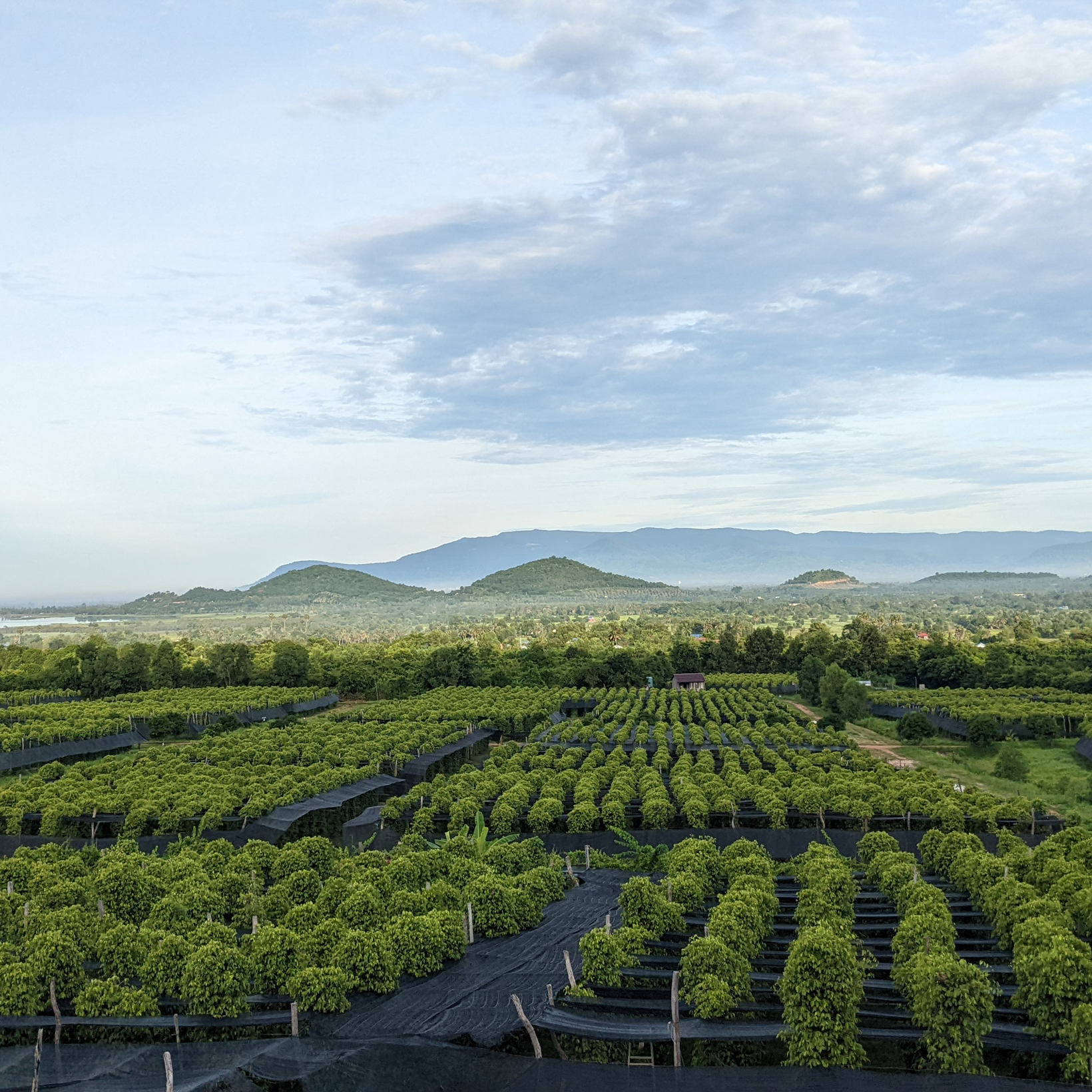
La Plantation’s organic supply chain covers more than 60 certified hectares. The company’s own farm accounts for 40 hectares, on which more than 15 plants are grown, processed on the day of harvest to preserve their freshness.
This production is supplemented by a cooperative of 20 farmers, certified under La Plantation’s oversight, representing approximately 6 additional hectares. La Plantation fully funds the organic certification of these farmers, provides training in organic growing methods and guarantees to purchase their entire organic output at above-market prices.
Two independent organic producer groups based in other Cambodian provinces complete the network with around 15 further hectares. This model allows the diversity of Cambodian terroirs to be showcased while maintaining full traceability from plot to finished product.
FAQ – Organic Spices
Yes. A certification compliant with European regulation EU 2018/848 imposes the same production requirements on certified farms in Cambodia as on those located within the European Union. La Plantation’s organic products are audited by Ecocert under this standard, with additional traceability obligations applying when they are imported into Europe.
An organic spice is grown without synthetic fertilisers, chemical pesticides or GMOs, under a framework controlled by an independent certification body. A conventional spice is not subject to these restrictions and may be grown with chemical inputs, with no obligation of certification or external audit.
La Plantation has been certified organic since 2016 by Ecocert, an independent certification body. The certification covers the European standard (EU 2018/848) and the American USDA Organic standard (NOP) for the products and activities concerned.
Not automatically. The PGI (Protected Geographical Indication) certifies the geographical origin and the production method specific to Kampot pepper. The organic certification is a separate label. La Plantation’s Kampot PGI peppers carry both — but the two certifications are independent of each other. Always check the product label to confirm both are present.
Fresh salt-pickled pepper is Kampot or Kampong Thom pepper preserved in Kampot PGI fleur de sel rather than dried. It retains the texture and freshness of a berry at peak ripeness. The salt-pickled format is available in the organic range and is certified by the same Ecocert standard as the other products.